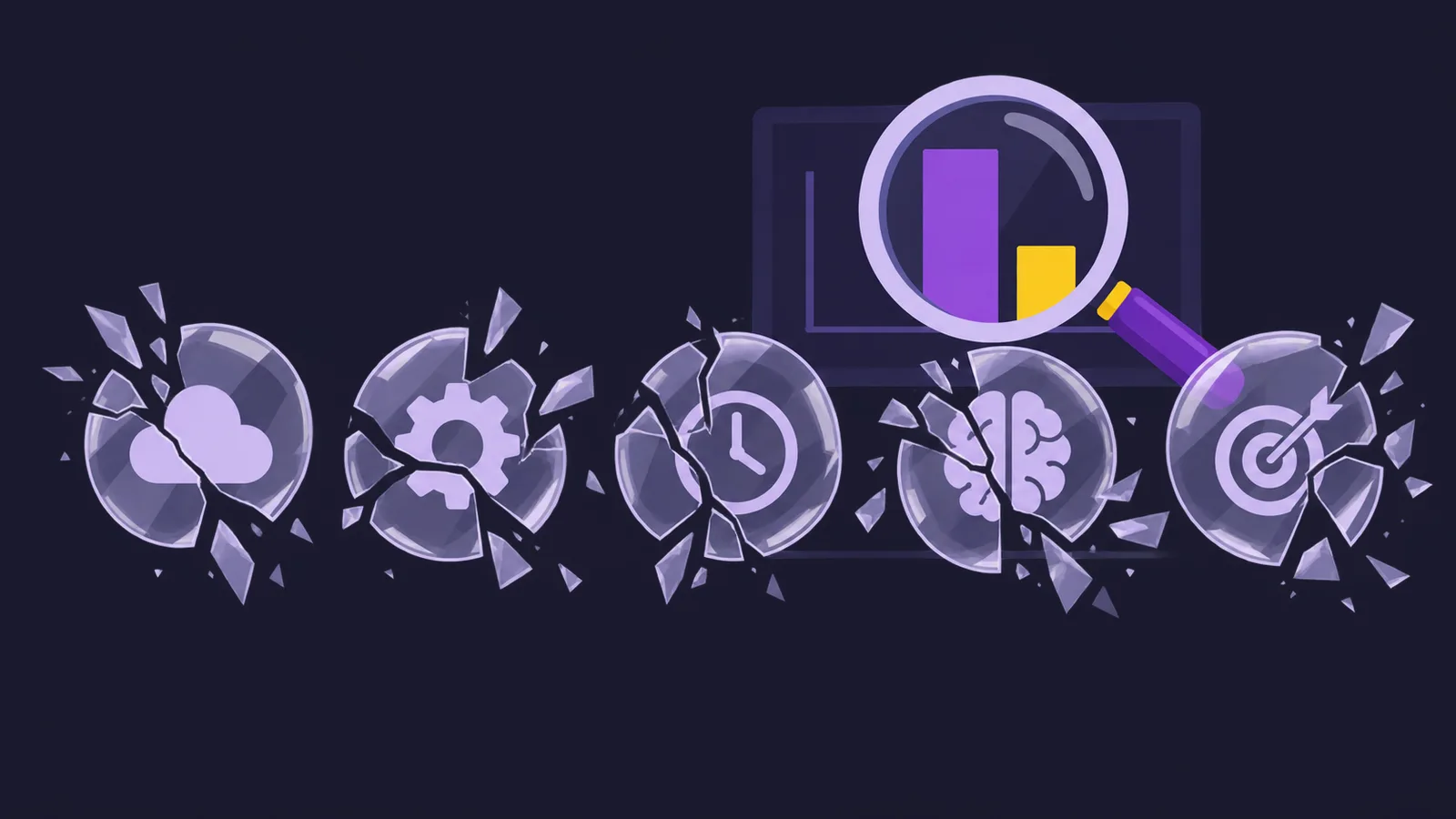
5 AI Test Generation Myths QA Teams Still Believe in 2026

Switching from DeepSeek V3 to Claude Sonnet 4 on the same end-to-end test workload took success rates from 34.3% to 70.1%. That is a 2× swing from model selection alone (De Souza et al., WebMedia 2025). That single data point dismantles the dominant assumption that "AI test generation" is one technology with one quality profile. It is not.
AI testing has accumulated five durable myths that QA teams keep treating as settled. They are not. Each is contradicted by 2024-2026 benchmark evidence and named industry deployments at Meta, Microsoft, and across the academic literature. The verdicts below are sharp because the data is.
This post stays on generation and what the benchmarks say about it. For the wider picture, the agent loop, memory, ChatOps and what to ask vendors, see our AI testing agents guide.
1. High coverage means your AI-generated tests are good
MUTGEN reported cases where LLM-generated suites reached 100% line coverage with only 4% mutation score. The tests executed every line but caught essentially no introduced faults (MUTGEN, accepted IEEE TSE 2025). Meta's ACH framework was built specifically around this problem. ACH applied mutation-guided generation to 10,795 Android Kotlin classes across seven platforms, produced 9,095 mutants and 571 hardening tests, and engineers accepted those tests at a 73% rate (Source: Meta Engineering, 2025). The choice to use mutation rather than coverage as the optimization target was deliberate. Coverage tells you which lines were touched. Mutation tells you whether the test would have noticed if those lines lied.
The 2026 ULT benchmark put this gap on the record at scale. Across 3,909 decontaminated real-world Python functions, the best models averaged 41.32% accuracy, 45.10% statement coverage, 30.22% branch coverage, and a 40.21% mutation score. Branch coverage and mutation score were both materially lower than the headline statement-coverage number. Coverage flattered the model. Mutation didn't.
The ladder, bottom to top: compile or parse success, execution pass rate, locator stability, branch coverage, mutation score, flake rate in CI, and survival under code evolution. A suite that clears the top three rungs is one you can act on; one that only clears the bottom two is a demo.
2. Description-only test execution is production-ready
The most rigorous analysis comes from Bouzenia et al. (2025), who explicitly call NL test cases "unsound" because their actions are not formally defined as inputs. Consistent behavior across runs is impossible to guarantee without external guardrails. Testing eight LLMs from 3B to 70B parameters, only Meta Llama 3.1 70B achieved execution consistency above the 3-sigma level. Smaller models failed (Source: Bouzenia et al., arXiv:2509.19136, 2025).
The benchmark numbers reinforce this. Top browser-agent systems on WebVoyager and VisualWebArena plateau in the 60–85% task-completion range against a human baseline of around 89%, and the AgentRewardBench analysis (Lù et al., 2025) found that LLM-as-judge agreement with humans drops sharply at long horizons in WebArena and VisualWebArena trajectories. A test that succeeds at three steps and fails at twelve is not a regression test. It is a coin flip.
The Liénard et al. PinATA study crystallizes the architectural reason. Testing requires both correct actions and correct verdicts at intermediate steps, not just final-state task completion. PinATA hit 61% correct test execution with 94% sensitivity on offline applications. Strong for an emerging category, nowhere near the determinism CI/CD pipelines assume (Source: PinATA, arXiv:2504.01495, 2025).
3. AI self-healing eliminates test maintenance
Capgemini's 2024 World Quality Report put 36% of QA budget on test maintenance, and Google's testing-blog data has cited 16% of tests as flaky, consuming more than 2% of total engineering time (Source: Google Testing Blog, 2020). Self-healing helps with the locator subset of this cost. It does not help with logic errors, data-dependent flakiness, application-level regressions, or major UI-flow changes where the button moved to a different page that now requires login.
There is no independent head-to-head benchmark for the major self-healing claims (Octomind's 78%, Mabl's 95%, Testim's 60%). And the most concerning recent finding cuts the other way. Berndt et al. reported that LLM-generated tests are slightly more flaky than human-authored tests, with flakiness transferring from prompt context (ICSE-SEIP 2026). A separate Berndt paper found LLMs perform only marginally better than random guessing when classifying flakiness from test code alone (arXiv:2602.05465, 2026).
There is a sharper way to put this. Most vendor self-healing pitches are pricing a feature that fixes the symptom they used to charge you for. The actual maintenance problem in mature test suites is rarely the locator. It is the assertion that no longer matches business logic, the data fixture that drifted, the flaky 200-millisecond race condition. Self-healing leaves all of those alone.
4. Any LLM works equally well for test generation
De Souza et al. (WebMedia 2025) ran the Suna E2E test agent across nine websites with two backing models on identical tasks. Claude Sonnet 4 achieved 70.1% test success (336 of 479). DeepSeek V3 achieved 34.3% (165 of 481). Same tooling, same task definitions, 2× difference. Cost per successful test on the paid model was $0.15.
That number is not an outlier. The Korraprolu et al. 2025 study compared six LLMs on natural-language requirements testing and found coverage metrics varying widely by model. The Mhira et al. 2024 systematic review of 55 AI testing tools confirmed that LLM backbone is the variable that moves results most, more than the surrounding tool architecture (Source: Mhira et al., arXiv:2409.00411, 2024).
Why does this fly under the radar? Vendor marketing rarely names the backing model. Buyers compare tool feature lists, not the LLM underneath. And once a tool is integrated into CI, swapping out the model is invasive. The architectural decision masquerades as a procurement decision.
5. Once AI generates the tests, humans are out of the loop
Across the Ministry of Testing community, only 67% of practitioners trust AI-generated tests when human review is part of the workflow, a number that drops sharply for fully autonomous proposals. Rahul Parwal's widely-cited agent maturity model places the current sweet spot at Level 2-3 (workflow and semi-autonomous), with Level 4 autonomous test agents flagged as "risky without solid infrastructure" (Source: Ministry of Testing community discussion, 2026).
The empirical evidence aligns. The GenIA-E2ETest study reported a 10% average manual modification rate on generated E2E tests (median 6%), but with one complex test case requiring 49% modification. That is exactly the long-tail variance that breaks naive auto-merge (Source: Ribeiro et al., arXiv:2510.01024, 2025). TestSprite's headline claim of jumping from 42% to 93% pass rate "after iterative refinement" is itself an admission. Single-pass generation is not good enough.
Even Meta's ACH framework, arguably the most successful production deployment of LLM-generated tests, requires engineer approval before any hardening test merges. The 73% acceptance rate is not a 100% acceptance rate.
Key Takeaways
FAQ
Is AI test generation worth adopting in 2026, given these limitations? Yes, for specific use cases. AI is reliably useful for accelerating test authoring (60% time reduction reported in the AWS/Schaeffler case study), regression scaffolding from requirements, and test data generation. It is not yet reliable as an autonomous regression runtime. The right adoption pattern is AI-assisted authoring with deterministic execution, gated by human PR review.
What metric should replace line coverage for AI-generated test quality? A combination, not a single replacement. Use mutation score for fault-detection quality, flake rate for CI stability, branch coverage for code-path completeness, and pass-rate survival under code evolution to detect over-fitting. The 2026 ULT benchmark shows all four can diverge sharply on the same suite.
How big is the actual model-quality gap for E2E test generation? Approximately 2× on documented benchmarks. Claude Sonnet 4 hit 70.1% success versus DeepSeek V3's 34.3% on identical E2E tasks (De Souza et al., 2025). Six-LLM comparisons (Korraprolu et al., 2025) show similarly wide variance. Cheaper models can work, but only after empirical validation on a representative sample of your own application.
Does self-healing actually reduce maintenance, or just shift it? It reduces locator-maintenance work and shifts the rest. Selector drift (renamed elements, restructured DOM) is genuinely automated. Logic drift, data drift, and behavioral changes still require human attention. Berndt et al. (ICSE-SEIP 2026) found LLM-generated tests slightly flakier than human-authored ones, so net maintenance can stay flat or rise without strong process controls.
What is "supervised autonomy" in practice? Level 2-3 of Rahul Parwal's agent maturity model. The AI proposes test scripts or modifications, a human engineer reviews and approves, and the merged artifact is a deterministic Playwright or Cypress test that runs without further AI calls. PR-based workflows, audit trails for approvals, and a clear escalation path for ambiguous cases.
Where this leaves teams
The honest summary is that AI test generation works, has documented limits, and rewards teams that calibrate their expectations to the evidence. The myths above persist because they are useful: to vendors selling autonomy, to QA leads pitching investment, and to engineers hoping AI will absorb the parts of their work they enjoy least. None of those constituencies want sharp evidence.
If you're evaluating AI testing tools, the practical next step is small. Pick 20-50 tests from a representative production application, run them through two candidate stacks with different backing models, and compare mutation score, flake rate, and time-to-merge. That single experiment will resolve more vendor claims than any analyst report.
That experiment is also what a Wopee.io pilot is built around: your application, a fixed scope, and measured results rather than a vendor's slide.
Keep reading
All postsWopee.io Quick Start: Your First AI Test in 6 Minutes
Paste a URL, let the AI agent explore your app, read the verdict, schedule a test plan and find every test in your own GitHub repo. A 6-minute walkthrough.
Oct 12, 2026How to Start with AI in QA: The 4 Questions Every Team Asks
Four questions QA teams ask about AI, answered as one loop: validate docs, derive scenarios, generate tests, draft bugs. A person presses the last button.
Sep 9, 2026Wopee.io vs Playwright: 2026 Honest Comparison
Playwright is a free framework; Wopee.io is the autonomous platform built on top of it. Honest 2026 comparison of when each one is the right pick.
May 26, 2026